

One thing I see new traders struggle with is learning how to segment the day.
Over the past two years, trading volume has increased by more than 44%. That means there are more plays spread throughout the day. So, finding the right approach to each segment of the day is more important than ever.
10 AM ET Today: Tim Sykes Reveals “The 15 Market Minutes That Matter MOST”
Table of Contents
The Big Picture
Years ago, when I started trading, we used to trade for an hour in the morning and 90 minutes in the afternoon.
At the time, I was trying to run a business and couldn’t trade much. On days when I could trade in the morning, I’d just pile into stuff. It didn’t always end well.
Eventually I figured out that the afternoon session was better for my schedule. So, I traded pretty much one pattern in the afternoon for several years.
Once I made the jump to full-time trading, I had to figure out what to trade during the hour in the morning.
Fast forward to today and there are a lot more choices…
Trading “Time Zones”
In the most basic sense, the segments of the day are:
- Premarket
- Market open: 9:30 to 9:45 a.m. ET
- 9:45 a.m. to 2 p.m. ET
- 2 p.m. and later
- After-hours trading
Now, you can trade from 4 to 7 a.m, but I prefer to wait until 7 a.m. because that’s when volume really comes in.
The reason is, many brokers don’t allow early premarket trades. Or they require you to sign a few documents to acknowledge the risk.
I do watch what’s going on before 7 a.m., but it’s also my personal time to read scripture, work out, and get ready for the day.
So, for me, premarket trading means 7 to 9 a.m.
Now, there’s some overlap, but…
At Different Times of Day, Look for Different Setups
For example, I focus on RCTs from 7 to 9 a.m. As we head into the market open, I pretty much exclusively use the Oracle signals.
Quick aside: I encourage new traders to avoid the first 15 minutes after the open. That little window chews up more new traders, by far, than any other part of the day. Watch the 9:45 Rule Explained video to understand why.
So, it’s all Oracle signals at the market open. As midday comes around, we flip over to dip-and-rips. And as the end of the day comes around, we flip over to VWAP holds.
Finally, as after-hours comes back, we transition back into RCTs.
My Take
The key lesson here is that there are different stocks, different setups, and different patterns based on the time of day. There’s some overlap, but there’s a unique way to approach each segment of the day.
Watchlist
On August 18, TruGolf Holdings, Inc. (NASDAQ: TRUG) announced it had entered into an agreement to acquire Polymath Research, a Canada-based Layer-1 blockchain company.
On Friday, Polymath announced a partnership with High Ridge Trust, fueling a big move:
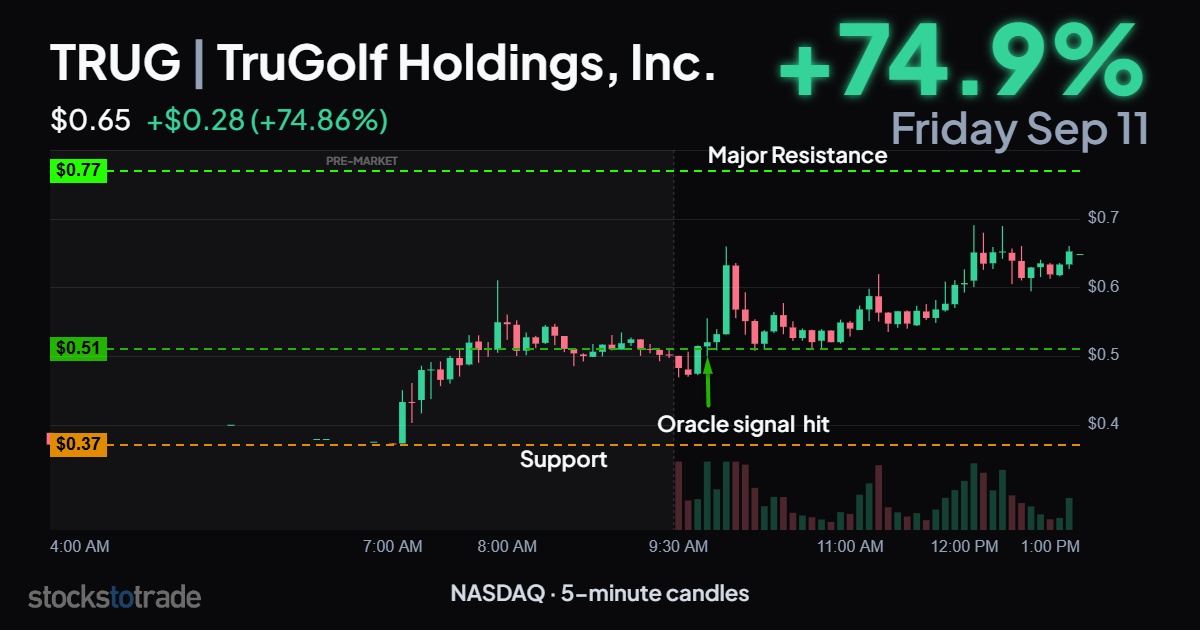
TRUG, 9/11/26, Oracle support, signal, major resistance
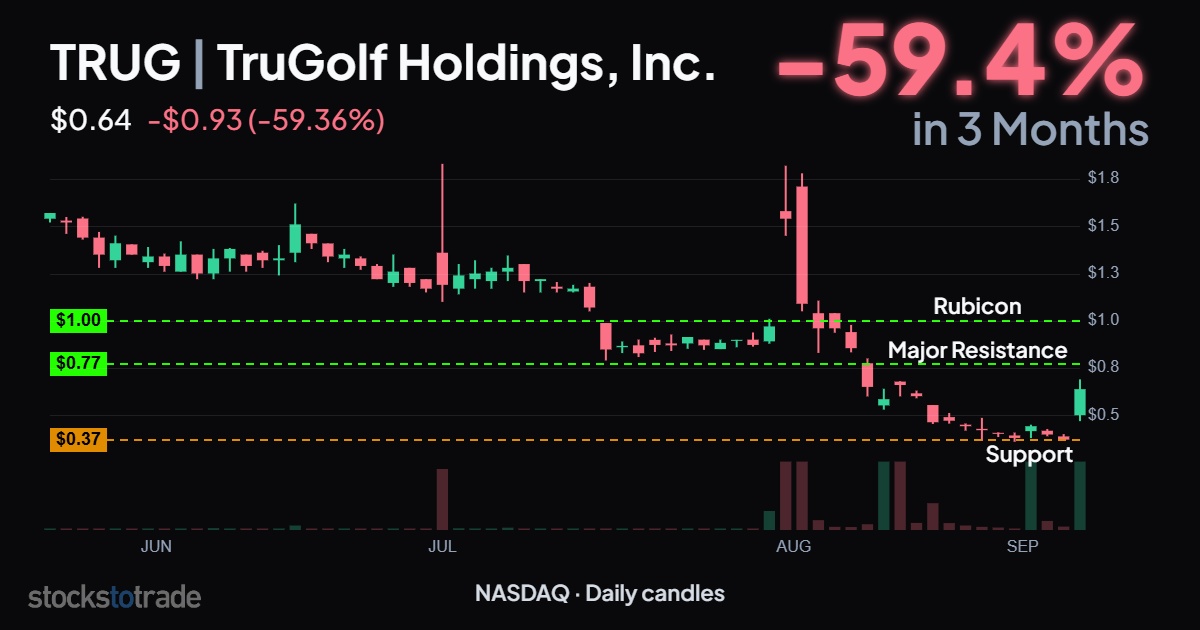
The 3-month chart shows why the major resistance (M/R) level is $0.77:
TRUG, 3-month, daily candles, support, M/R, Rubicon
If TRUG continues to hold between $0.60 and Friday’s high-of-day, look for a push through the M/R level.
If it flips the M/R, watch for the dollar cross. The August spike shows that TRUG can run if it crosses the Rubicon.
On My Radar
- Squashed like a bug: so much for Dario and Sam’s coronation dreams
- Steady inflation likely means a rate increase
- We’ll find out after the FOMC statement on Wednesday (Sept. 16)
- Be sure to check out last night’s Sunday Market Brief if you weren’t there
- Ben Sturgill’s Simpler Options Bootcamp starts tomorrow (I HIGHLY recommend it)